The World Nomad Games are often seen primarily as a major sporting and cultural celebration. For Kyrgyzstan, however, their significance is much broader. They are an international showcase for the country, an instrument of cultural diplomacy and an opportunity to establish a distinctive place on the global tourism map.
The VI World Nomad Games are taking place in Kyrgyzstan from 31 August to 6 September 2026. According to Kabar, more than 3,000 athletes from 109 countries are participating. The programme brings together 43 ethno-sports disciplines, cultural events and traditional knowledge. An event on this scale attracts the attention of international media, official delegations, athletes, content creators and travellers.
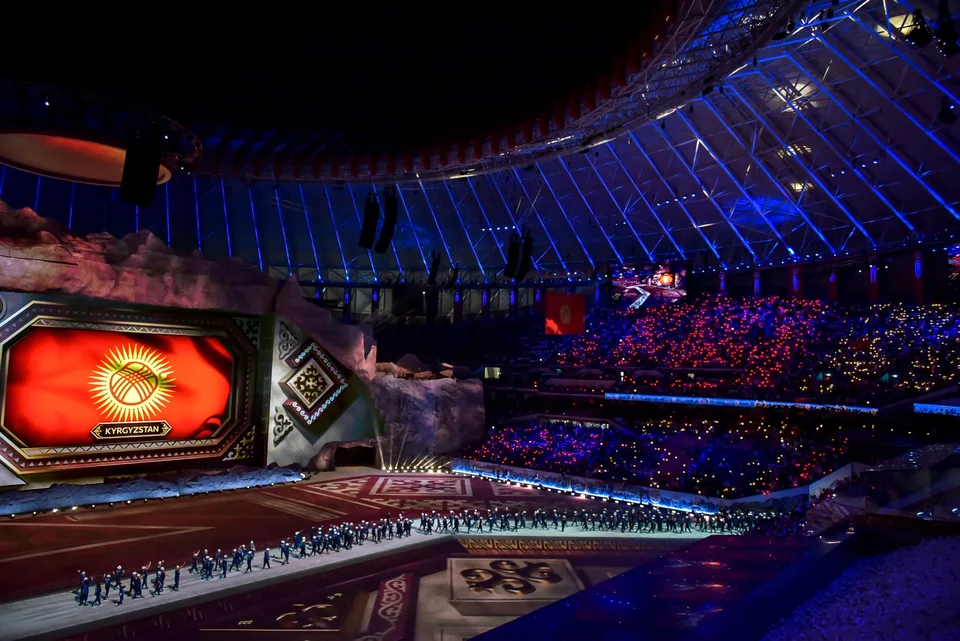
Cover photo: Press Service of the President of the Kyrgyz Republic.
The Games' greatest value, however, lies not only in the number of participants and spectators. It lies in the image of Kyrgyzstan that remains with global audiences after the event has ended.
A country with an identity of its own
In the international tourism market, Kyrgyzstan competes not only with neighbouring countries. It competes for the attention of travellers choosing among dozens of countries, routes and recommendations.
Beautiful mountains, lakes and horse-riding routes can be found in many countries. Natural beauty alone is therefore not enough. Kyrgyzstan needs a recognisable identity that cannot be confused with another destination.
The World Nomad Games help create precisely that identity. Mountains, horses, yurts, traditional games, music, crafts, cuisine and customs come together to form a coherent image of the country. This is not an artificial marketing concept. It is part of our history and identity, presented in a contemporary international language.
The idea and initiative for the World Nomad Games came from Kyrgyz citizen Askhat Akibaev. He developed a concept that brought together ethno-sports, culture and the traditions of nomadic peoples in a single international format. In December 2025, Akibaev transferred the project's intellectual property rights to the state so that the Games could continue to develop as a national brand of the Kyrgyz Republic.
The Games were first held in Kyrgyzstan in 2014. They later expanded beyond the country and were hosted by Türkiye and Kazakhstan. Upon returning home in 2026, the project received fresh momentum from the state and reached an unprecedented international scale. The participation of more than 100 countries and thousands of competitors, together with the opening ceremony in Bishkek and the main events at Issyk-Kul, showed that an idea born in Kyrgyzstan had grown into a genuine global event.
This point matters: the World Nomad Games are not a borrowed format. They are an idea born in Kyrgyzstan, recognised internationally and entering a new stage of development on Kyrgyz soil.
From a compelling image to an actual trip
A major event creates a news story that conventional tourism advertising cannot fully replicate. A single striking report from Issyk-Kul or Kyrchyn can introduce millions of people to Kyrgyzstan for the first time.
Media reach alone, however, does not automatically translate into tourism growth. Someone may watch a beautiful ceremony, react to it on social media and never think of the country again.
Interest in the Games must therefore develop into interest in Kyrgyzstan as a whole. After discovering the country through an international event, a potential visitor should be able to find enough information and convenient options to plan a trip. Once here, that person can visit not only the sporting venues but also Bishkek, Karakol, mountain gorges, national parks, historical sites and craft centres, while experiencing national cuisine and local life.
The more regions a visitor explores and the longer they stay, the greater the economic impact. Their spending is distributed among hotels, guesthouses, restaurants, transport providers, guides, artisans and local producers. The benefits then reach not only organisers and large companies but also small businesses in the regions.
If the trip leaves a strong impression, the visitor may return or recommend Kyrgyzstan to others. This is how short-term international attention becomes lasting interest in the country as a destination.
Changing perceptions of Kyrgyzstan
For many people abroad, Central Asia remains a relatively unfamiliar region. Kyrgyzstan is often perceived as a small post-Soviet country about which little is known internationally.
The World Nomad Games can change that perception.
Global audiences see a country that not only preserves its heritage but can also turn it into a modern international product. Kyrgyzstan appears not as a peripheral state, but as the centre of a broad cultural space connecting the peoples of Central Asia, the Caucasus, Türkiye, Mongolia and other regions.
This shift matters. A strong national image affects more than visitor numbers. It supports diplomatic engagement, the hosting of international events, greater investor interest and broader recognition of Kyrgyzstan.
In this sense, the World Nomad Games are an effective instrument of soft power. Kyrgyzstan is not imposing anything or trying to persuade others through grand statements. It is presenting its culture, hospitality and ability to bring together representatives of more than 100 countries around a shared idea.
Tourism as part of the economy
According to the National Statistical Committee, 5.31 million people used Kyrgyzstan's organised and informal tourism sectors in 2025, an increase of 45.2 percent over the previous year. In the Issyk-Kul Region, the number of visitors rose from 1.99 million to 2.63 million. At the same time, the number of tourism businesses, guesthouses and households receiving visitors also increased.
The World Nomad Games are taking place against this background of growth and can further strengthen interest in the country. It would be wrong, however, to attribute rising visitor numbers to a single event. Transport links, visa rules, safety, road quality, infrastructure, service standards and international promotion all play an important role.
The Games create attention. The state and the tourism industry must turn that attention into lasting economic results.
The main work begins after the Games
One common mistake in hosting major international events is to assume that the work ends with the closing ceremony. In reality, the most important stage begins after the event is over.
The interest already generated must be sustained. Kyrgyzstan needs ready-to-book tourism routes linked to nomadic culture, regular ethno-sports events, high-quality information about the country in several languages and continuous engagement with international media, tour operators and digital platforms.
Transport, wayfinding, booking systems, sanitation infrastructure and guide training also need improvement. Results should be measured not only by the number of visitors, but also by how long they stay, how much they spend in the country and how many return.
Without this work, the impact of the World Nomad Games may be impressive but short-lived. With a consistent approach, the Games can become the foundation of Kyrgyzstan's long-term tourism brand.
Our competitive advantage
The World Nomad Games show that national culture does not have to remain solely in the past or in museum displays. It can become a contemporary economic, tourism and diplomatic resource.
Kyrgyzstan does not need to copy other countries' promotional models. Our advantage lies precisely in what others do not have: the origin of the Games, a living nomadic culture, the natural landscape and the ability to combine tradition with a modern international format.
The World Nomad Games have already given Kyrgyzstan two essential assets: global attention and a recognisable identity.
The task now is to turn one week of global attention into years of tourism interest. If, after the Games, an international viewer does more than remember a beautiful ceremony and decides to visit Kyrgyzstan, see Issyk-Kul, follow mountain routes, experience the culture and eventually return, then the event will truly have fulfilled its central purpose.