The Our World in Data chart comparing energy use and GDP per capita highlights one of the key challenges facing Kyrgyzstan today.
For Kyrgyzstan, the chart shows about 7,650 kWh of total energy use per person and GDP per capita of around 7,200 international dollars at purchasing power parity in 2021 prices. For comparison, energy use is about 15,900 kWh per person in Uzbekistan, around 43,700 kWh in Kazakhstan and more than 20,200 kWh globally.
One clarification is important. This is not electricity consumption alone. Our World in Data uses total energy supply, which includes electricity, fuels, heat and other energy sources. Where 2025 data are not yet available, the chart uses the closest available value from 2020 to 2024.
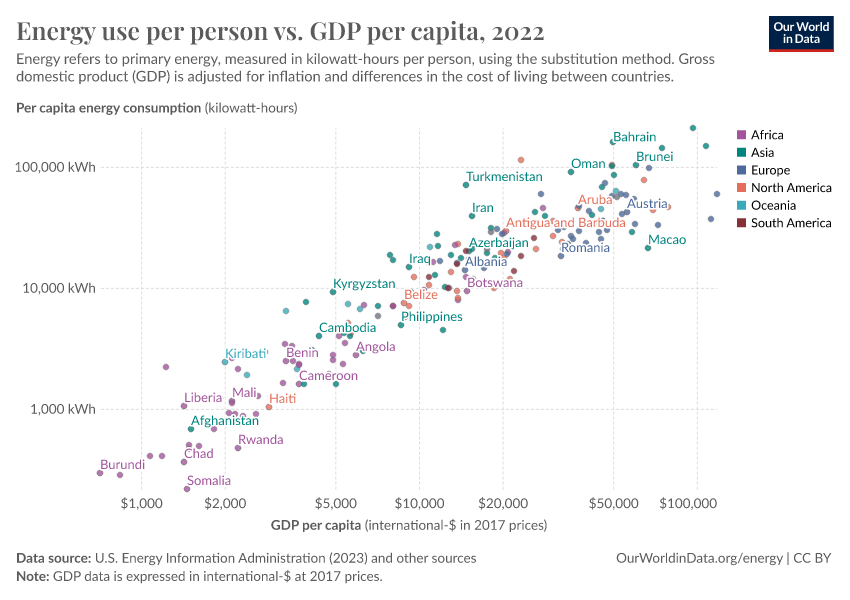
Energy use per person versus GDP per capita, 2025. Source: Our World in Data, Energy Institute, Statistical Review of World Energy 2026 and other sources. Accessed 4 October 2026.
The broader picture is clear. Kyrgyzstan still has a relatively low level of energy availability per person.
Economic growth needs an energy base
Growth in construction, industry, processing, transport, tourism, digital infrastructure and urban development inevitably increases demand for electricity.
According to the Ministry of Energy, total electricity consumption in Kyrgyzstan reached 19.3 billion kWh in 2025, while domestic generation was 15.4 billion kWh. Imports were around 3.8 billion kWh.
This is why new generation capacity can no longer be treated only as a sectoral issue for the power industry.
If the country wants to attract new manufacturing, develop industrial zones, build large investment projects and expand electric transport and digital infrastructure, electricity supply must cover more than current demand. The system also needs capacity for future growth.
What is already changing
In recent years, the state has been working in several directions at the same time.
In 2025, eight small hydropower plants with a combined capacity of 44.59 MW were commissioned. According to the Ministry of Energy, the installed capacity of operating solar power plants reached about 101.95 MW by the beginning of 2026.
Modernization of major hydropower plants is also continuing. After the reconstruction of four generating units, the capacity of the Toktogul Hydropower Plant increased by 240 MW. Additional capacity was also added at the Uch-Kurgan Hydropower Plant in 2025.
In addition, investment agreements were signed in 2025 for five solar projects and one wind project with a combined planned capacity of 3,150 MW and total investment of around 4.2 billion dollars.
This points to a broader energy development model that combines modernization of existing hydropower, construction of new hydropower facilities, expansion of solar and wind generation and greater use of private capital.
Kambarata-1: a project of a different scale
The central project remains the Kambarata-1 Hydropower Plant.
According to the World Bank, the planned capacity of the plant is 1,860 MW, with expected annual generation of about 6,000 GWh, or roughly 6 billion kWh.
For comparison, that is equivalent to almost 39 percent of all electricity generated in Kyrgyzstan in 2025.
The project is being developed in a regional format involving Kyrgyzstan, Kazakhstan and Uzbekistan. The World Bank is providing technical support, considering financing and coordinating with other international financial institutions.
The significance of Kambarata-1 goes beyond covering the current supply gap. Capacity on this scale could create an additional energy reserve for industry, new investment and deeper integration of Central Asian power systems.
Hydropower also brings another advantage. Dispatchable generation can help balance solar and wind capacity, which varies with weather conditions and time of day.
Renewables: from announcements to operating assets
The expansion of Kyrgyzstan's energy system is not limited to hydropower.
One of the clearest examples of private investment in renewables is already operating in Issyk-Kul.
In the Kyzyl-Oruk area, ROX Energy Global, through RECA LLC, is implementing a major solar power project with a planned total capacity of 1,900 MW.
The first phase was inaugurated on 14 June 2026. The Ministry of Energy reported the commissioning of 175 MW, together with a 110 kV substation and power transmission infrastructure.
Investment in the first phase amounted to around 130 million dollars. Expected annual generation from the first phase is approximately 192 million kWh.
Total announced investment in the project is around 1.4 billion dollars. Once fully implemented, installed capacity is expected to reach 1,900 MW. Official sources estimate potential annual generation from the full project at about 3.3 to 3.5 billion kWh.
The National Investment Agency notes that public authorities supported the project, including preparation of the investment agreement and application of support measures provided by law.
This example matters for two reasons.
First, it shows that major new generation capacity does not have to be financed only from public resources.
Second, it demonstrates that foreign private capital can be attracted not only into trade, construction or extractive industries, but also into long term energy infrastructure.
Hydropower and solar are complementary
For Kyrgyzstan, it would be a mistake to frame hydropower, solar and wind as competing options.
Each source has a different role.
Large hydropower plants provide scale and dispatchable generation. Small hydropower plants can use local hydro potential. Solar projects can be developed in stages and relatively quickly while attracting private capital. Grid investment allows these sources to operate within one integrated system.
Kambarata-1 and the ROX Energy solar project in Issyk-Kul can therefore be viewed as two different mechanisms serving the same objective: increasing domestic generation and creating an energy reserve for future development.
More energy alone is not enough
The Our World in Data chart also illustrates the other side of the issue.
High energy use does not automatically make a country wealthy. Some countries consume large amounts of energy while producing relatively modest GDP. Others create much more economic value with moderate energy use.
Kyrgyzstan therefore should not aim only to move upward on the chart by using more energy.
It also needs to move to the right by increasing GDP, productivity and value added.
New megawatts should translate into growth in processing industries, export oriented production, industrial enterprises, data centers and digital infrastructure, electric transport, modern utility systems and energy efficient construction. Ultimately, this should mean more jobs and a broader tax base.
This is where energy policy connects directly with investment and industrial policy.
From covering shortages to powering development
For many years, energy discussions in Kyrgyzstan focused heavily on how to get through the autumn and winter period and meet rising consumption.
The scale of the task is now changing.
Kambarata-1, modernization of the Toktogul and Uch-Kurgan hydropower plants, construction of small hydropower plants, development of solar and wind generation, new substations and grid projects, as well as large private renewable energy projects all indicate that the country's energy base is gradually expanding.
This does not remove existing constraints. The gap between domestic generation and electricity consumption remains significant, while large projects require time, capital, reliable grids and effective management.
But the direction of change can already be measured through specific projects and commissioned capacity.
This is where the Our World in Data chart becomes practically relevant.
Kyrgyzstan does need more energy. But the ultimate objective is not higher consumption for its own sake. New megawatts must translate into investment, production, jobs and higher value added.
If that happens, energy can shift from being one of the constraints on economic growth to becoming one of its main drivers.