For many years, relations between Kyrgyzstan and Vietnam were shaped more by individual historical episodes than by continuous political and economic engagement. That is now changing.
Historical memory is gaining renewed symbolic value, high-level contacts are becoming more active, bilateral trade is growing and, most importantly, major Vietnamese investments are taking shape in the Kyrgyz economy.
A particularly important role in this process is being played by ROX Group. In a relatively short period, the group has established a presence in Kyrgyzstan across urban development, energy, real estate and broader investment activity.
This is no longer simply a story of occasional business contacts between two countries. It is about capital investment, infrastructure, job creation, local capacity building and the emergence of a long-term economic presence.
Sixty-seven years separate Ho Chi Minh's visit to Frunze in the summer of 1959 from the unveiling of his monument in Bishkek on 31 August 2026. Yet the most visible changes in Kyrgyz-Vietnamese relations have taken place only in recent years.
Ho Chi Minh in Frunze
Ho Chi Minh visited Soviet Kyrgyzstan in the summer of 1959 as part of a broader trip across the Soviet Union.
He arrived in Frunze on 28 July 1959. The programme was short and largely introductory: he toured the city, visited the Strelnikov state livestock farm and attended the republican agricultural exhibition.
During the visit to the farm, Ho Chi Minh was presented with a set of Kyrgyz national clothing. Photographs showing him in Kyrgyz dress and a traditional kalpak remain among the most recognisable visual records of the trip.
The visit was brief, but over time it acquired symbolic significance. Ho Chi Minh became one of the best-known international political figures of his era to have personally visited Soviet Kyrgyzstan.
A historical connection renewed 67 years later
On 31 August 2026, a monument to Ho Chi Minh was unveiled at Royal Central Park in Bishkek.
The ceremony was attended by Speaker of the Jogorku Kenesh of the Kyrgyz Republic Marlen Mamataliev, Vice President of Vietnam Vo Thi Anh Xuan, representatives of state institutions, the diplomatic community, business and invited guests.
The location itself is significant. Royal Central Park is one of ROX Group's largest contemporary investment projects in Kyrgyzstan. A historical symbol of Kyrgyz-Vietnamese relations has therefore become directly connected with a new phase of economic cooperation between the two countries.
A new level of political dialogue
In late August 2026, Vice President of Vietnam Vo Thi Anh Xuan visited Kyrgyzstan. On 31 August, she met President of the Kyrgyz Republic Sadyr Japarov.
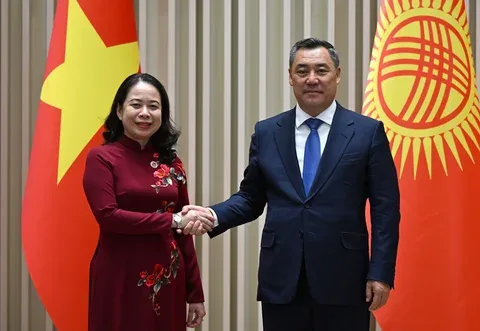
President of the Kyrgyz Republic Sadyr Japarov and Vice President of Vietnam Vo Thi Anh Xuan. Photo: Press Service of the President of the Kyrgyz Republic.
The talks covered trade and investment, transport and logistics, tourism, technology, and cultural and humanitarian ties.
The importance of the meeting lies not only in the political dialogue itself. There are now concrete investment projects behind that dialogue, particularly in energy and urban development.
According to the Vietnamese side, the visit was the first by a Vietnamese leader at this level since 1990, underlining the growing political significance of the relationship.
2025 became a turning point
A clear acceleration began in March 2025, when Chairman of the Cabinet of Ministers of Kyrgyzstan Adylbek Kasymaliev paid an official visit to Vietnam.
It was the first visit by a head of government of Kyrgyzstan to Vietnam since the establishment of diplomatic relations in 1992.
In Hanoi, discussions with the Vietnamese leadership and business community focused on trade, energy, industry, agriculture, transport, logistics and the attraction of Vietnamese capital to Kyrgyzstan.
From that point, the relationship began to move more visibly from diplomatic potential toward practical economic cooperation.
Trade is growing, but investment is moving faster
Bilateral trade between Kyrgyzstan and Vietnam remains relatively modest, although the trend is clearly upward.
In August 2026, Vietnamese Ambassador to Kyrgyzstan Nguyen Thanh Le noted that the two countries' 2025 trade statistics differed significantly. Vietnamese statistics put bilateral turnover at $17.6 million, while Kyrgyz statistics showed around $117 million, including $115.4 million in imports from Vietnam.
The discrepancy may reflect differences in statistical methodology, supply routes, re-export, and the way countries of origin and dispatch are recorded. Without comparing the underlying customs data, it would be inappropriate to draw a definitive conclusion about the cause.
The more important point is the direction of travel: economic ties are expanding, while their full potential remains far from exhausted.
At the same time, investment cooperation is already developing faster than traditional trade.
ROX Group as a practical driver of cooperation
Diplomacy creates the conditions for cooperation. Investment turns those conditions into measurable economic results.
Today, ROX Group is one of the clearest examples of this transition from political dialogue to practical economics.
Large-scale foreign capital is being deployed in Kyrgyzstan, new infrastructure is being built, jobs are being created and local contractors and suppliers are receiving new orders.
Investment also brings technology, international management experience and new professional competencies. Major projects involve architects, engineers, construction companies, equipment suppliers, transport operators, legal and financial specialists, and service businesses.
Once facilities enter operation, they also generate permanent employment in maintenance, management and infrastructure services.
On 31 August, President Sadyr Japarov highlighted successful examples of Kyrgyz-Vietnamese investment cooperation, including ROX Group projects.
For his contribution to the development of investment cooperation between Kyrgyzstan and Vietnam, ROX Group head Tran Anh Tuan was awarded the Kyrgyz Order of Dostuk.
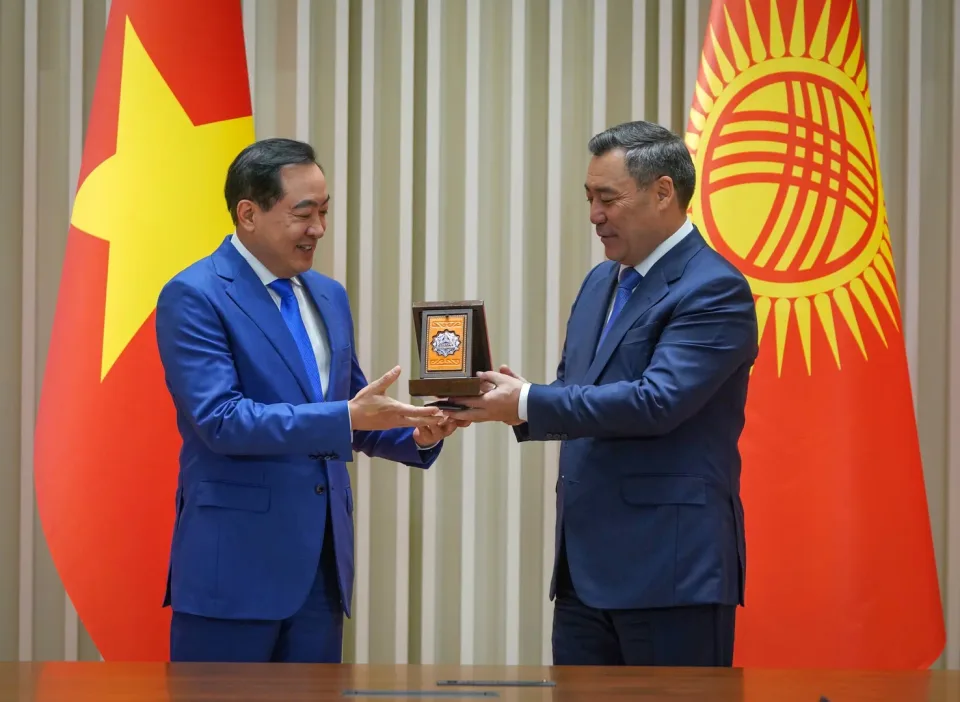
ROX Group head Tran Anh Tuan receives the Order of Dostuk. Photo: Press Service of the President of the Kyrgyz Republic.
The award is important not only as recognition of one investor. It also reflects the level that investment cooperation between Kyrgyzstan and Vietnam has reached in recent years.
Royal Central Park: investment in Bishkek's urban development
ROX Group's largest urban project is Royal Central Park, being developed on the site of the former Ak-Kula hippodrome.
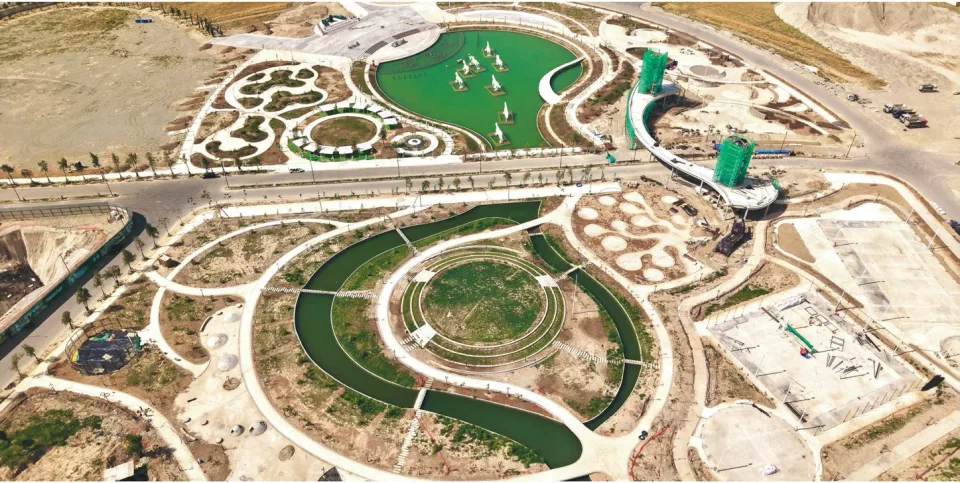
Royal Central Park in Bishkek. One of ROX Group's largest investment projects in Kyrgyzstan, based on the comprehensive redevelopment of the former Ak-Kula hippodrome. Visualisation: Royal Central Park.
The project is designed as a comprehensive redevelopment of a major part of the capital. It is not simply a residential development.
The concept includes modern residential buildings, commercial and business facilities, public spaces, social infrastructure, roads, pavements, park areas and engineering networks.
According to the terms published by Bishkek City Hall, payments to the city budget for the 49-year use of the site amount to KGS 5.8 billion.
The investor has also undertaken to build and subsequently transfer to the municipality social and infrastructure facilities worth around KGS 3.5 billion. These include three schools, three preschools, park areas, municipal roads, pavements and the necessary engineering networks.
Bishkek City Hall has estimated total investment in the project at approximately KGS 87 billion.
Royal Central Park should therefore be viewed not as another residential complex, but as a project of integrated urban development.
Projects of this scale create demand for architects, engineers, builders, designers, energy specialists, property managers and infrastructure operators. Alongside direct employment, they also generate indirect jobs in construction, logistics, materials supply, food services, transport and other sectors.
After completion, new permanent jobs emerge in property management, retail, services, education and urban infrastructure.
ROX Center: a permanent business presence
Another visible part of the group's presence is ROX Center in central Bishkek.
ROX Center serves as a permanent point of interaction with partners, government institutions, investors and the wider business community.
Its role is important because it demonstrates that the strategy is not based on one isolated project. It reflects a long-term institutional presence in Kyrgyzstan.
ROX Issyk-Kul: investment on a national scale
The scale of cooperation is especially visible in the energy sector.
The ROX Issyk-Kul project is designed for total solar generation capacity of up to 1,900 MW.
On 14 June 2026, the first phase with a capacity of 175 MW was commissioned. President of the Kyrgyz Republic Sadyr Japarov personally took part in the inauguration ceremony.
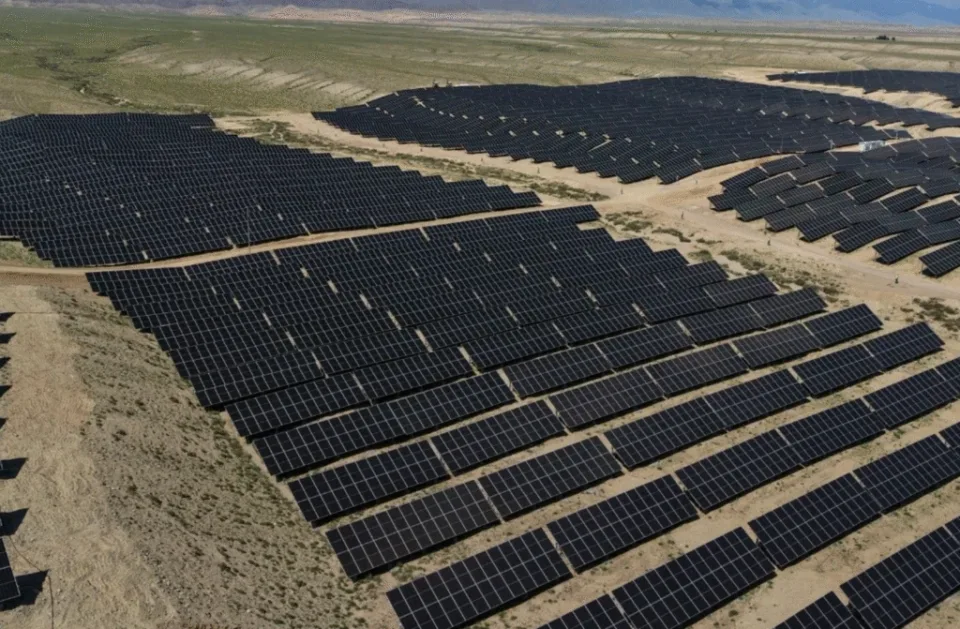
Opening of the first 175 MW phase of the ROX Issyk-Kul solar power plant. President Sadyr Japarov took part in the ceremony. Photo: Press Service of the President of the Kyrgyz Republic.
The first phase includes solar generation facilities, a 110 kV substation and the necessary transmission infrastructure.
Investment in this stage is approximately $130 million, while total investment in the full project is estimated at around $1.4 billion.
According to published information, more than 250 local residents were employed during construction of the first phase. Once the project is fully operational, around 150 permanent jobs are expected to be created.
President Sadyr Japarov has also noted that ROX Group's international experience in renewable energy contributes not only to new generating capacity, but also to the professional development of Kyrgyz specialists.
That is an important measure of foreign direct investment: not only the amount of capital deployed or the facility that is built, but also the jobs, skills, technology and long-term infrastructure that remain in the country.
For Kyrgyzstan, the project also has strategic significance. Additional solar generation helps diversify the country's energy balance and reduces dependence on hydrological conditions alone.
In this sense, the investment works simultaneously for economic growth, employment and energy security.
Jobs are one of the most important outcomes
Foreign investment is often discussed primarily in terms of millions or billions of dollars. Yet the economic impact depends equally on what happens after that capital enters the country.
Royal Central Park creates work for construction companies, architects, designers, engineers, manufacturers and suppliers of materials, transport businesses and service providers.
The energy project creates demand for engineers, power-sector specialists, technicians and operating personnel.
Some of this impact can be measured directly by the number of people employed. Another part is distributed through contractor and supplier chains.
That is why major foreign direct investment can have a multiplier effect well beyond the boundaries of an individual project.
Investment as a signal to other companies
There is another effect that is less visible but strategically important.
A major foreign investor also shapes the reputation of a market for other potential investors.
Companies considering entry into a new country look not only at legislation or investment presentations. They study the practical experience of businesses already operating there.
Can a large infrastructure project actually be implemented? How do investors and the state interact? Is financing available? Are there capable local contractors and skilled professionals? Can a project move from agreement to construction and operation?
Successful implementation of ROX Group projects can therefore have an impact far beyond the company itself.
For other Vietnamese businesses, it provides a practical case showing that major projects in Kyrgyzstan can move from negotiations to construction and operation.
One successful investor can help open the market to the next.
The Vietnamese community is growing alongside investment
Investment also creates human links.
According to Ambassador Nguyen Thanh Le, around 300 Vietnamese citizens live in Kyrgyzstan, many of them connected with ROX Group projects.
The community is still relatively small, but the trend is significant. Investment brings engineers, specialists and managers, creates day-to-day links between Kyrgyz and Vietnamese companies, and gradually expands cultural and professional exchange.
Economic relations begin to acquire a more durable human foundation.
The potential is much broader than the projects already under way
Despite recent progress, the full potential of Kyrgyz-Vietnamese cooperation remains largely untapped.
Promising areas include energy, agriculture and food processing, tourism, industry, construction, digital technologies, logistics and transport.
Kyrgyzstan is relevant to Vietnamese business not only as a domestic market. Its geographic position, participation in the Eurasian Economic Union and location between China, Central Asia and wider Eurasian markets give it additional strategic value.
Vietnam, in turn, is one of Southeast Asia's most dynamic economies and can provide Kyrgyz businesses with a platform for accessing ASEAN markets.
The free trade agreement between Vietnam and the Eurasian Economic Union also creates an additional institutional framework for expanding trade and investment.
From historical memory to a real economic relationship
In 1959, Ho Chi Minh came to Frunze, saw the city, visited a livestock farm and attended an agricultural exhibition.
Sixty-seven years later, a monument to him was unveiled in Bishkek.
That is an important symbol of historical connection. But the modern substance of Kyrgyz-Vietnamese relations is now being shaped not only by symbols and official visits.
It is visible in investment.
Capital is entering Kyrgyzstan. Energy and urban infrastructure is being built. Jobs are being created. Local companies are receiving contracts. Kyrgyz specialists are gaining new experience. Social and engineering infrastructure is expanding.
Within this process, ROX Group occupies a particularly important position.
Royal Central Park is creating a new urban environment and involves major investment in Bishkek's social and engineering infrastructure.
ROX Issyk-Kul is bringing investment on a national scale into the energy sector and is already creating employment for local residents.
ROX Center anchors the group's permanent business presence in the capital.
The significance of ROX Group for Kyrgyz-Vietnamese relations therefore cannot be measured solely by the volume of capital invested. The broader effect includes jobs, infrastructure, technology transfer, professional capacity, support for local businesses and the creation of a long-term economic presence in Kyrgyzstan.
Historical memory creates a basis for mutual respect. Political dialogue opens the door to cooperation. But it is real investment that turns relations between states into concrete economic results.
Today, ROX Group's projects are among the clearest examples of that transition in the relationship between Kyrgyzstan and Vietnam.