The first 210-metre tunnel on the Kyrgyz section of the China-Kyrgyzstan-Uzbekistan railway has been completed. On its own, this may look like a local construction milestone. In reality, the significance of the project is much broader.
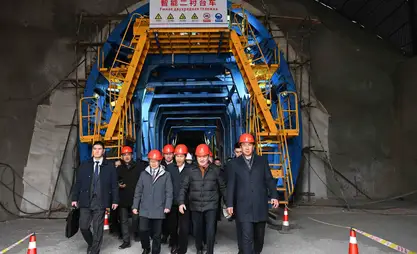
The project is creating a new transport corridor that could materially change Kyrgyzstan's position in Eurasian trade.
For many years, the country's geography was seen primarily as a constraint. Kyrgyzstan is landlocked, has difficult mountainous terrain and has historically not been directly integrated into the main railway routes connecting China with European markets.
The China-Kyrgyzstan-Uzbekistan railway has the potential to change that model.
The project in numbers
According to data published in September 2026, the total length of the railway will exceed 500 kilometres, with about 305 kilometres crossing Kyrgyz territory.
Work on the Kyrgyz section is under way on dozens of tunnels and bridges, as well as on sections of earthworks and future stations. The completion of the first tunnel matters above all because it confirms that a project discussed for decades at the political and expert level has moved into actual construction.
One of the project's defining technical features is the combination of two railway standards. China uses the 1,435 mm standard gauge, while Kyrgyzstan and other post-Soviet countries have historically used the 1,520 mm broad gauge. This requires transshipment infrastructure and a technological interface between the two systems.
As a result, certain points along the route may acquire economic importance far beyond their current role.
From transport periphery to transit corridor
The importance of the new railway for Kyrgyzstan is not limited to the ability to move cargo.
The route is expected to connect western China with Uzbekistan through Kyrgyz territory and then provide access to transport networks across Central Asia, the Caspian region, Türkiye and European markets.
For Kyrgyzstan, this creates a fundamentally different role.
The country can become not an endpoint in a logistics chain, but a full participant in it.
In international transport policy, this transition is often described as moving from landlocked to land-linked: from being constrained by the absence of direct sea access to using geographic position as a transport advantage.
That is precisely the opportunity now emerging for Kyrgyzstan.
The economic effect will go beyond transit fees
It would be a mistake to assess the project only through future revenues from freight transportation.
Major transport corridors create entire economic ecosystems around them.
Along the route, demand can emerge for logistics centres, warehouses, transshipment terminals, service companies, repair facilities, hotels, catering and other infrastructure.
Rail access can also change the investment attractiveness of individual regions of Kyrgyzstan.
For an industrial investor, logistics cost and reliability are among the decisive factors. If transport costs fall, projects that were previously considered uneconomic may become financially viable.
This is especially relevant for mining, agricultural processing, construction materials and other export-oriented industries.
Makmal could take on a new economic role
One of the important features of the project is the interface between different railway gauges.
China uses the 1,435 mm standard gauge, while the railway systems of the former Soviet Union predominantly use the 1,520 mm broad gauge.
A major transshipment hub is therefore expected to be developed in the Makmal area.
If implemented in full, Makmal could become more than a technical point for changing railway systems.
Logistics and industrial clusters often form around such transport nodes.
Over time, warehouses, container terminals, primary processing facilities, service companies and other businesses serving international freight flows could emerge there.
For the regional economy, this could become one of the most significant long-term effects of the railway.
A new logistics link between China and Europe
International media increasingly discuss the China-Kyrgyzstan-Uzbekistan railway in the context of diversifying Eurasian transport routes.
The new corridor could allow cargo from western China to move through Kyrgyzstan and Uzbekistan towards the Caspian region, Türkiye and European markets.
For international trade, this means the addition of another route within the broader Eurasian transport network.
The value of the project lies not in opposing existing corridors, but in expanding the number of available logistics options. For shippers, this increases routing flexibility, helps distribute infrastructure risks and provides additional delivery alternatives.
For Kyrgyzstan, the central point is different: the country gains an opportunity to enter this system not as a peripheral market, but as a full transit link.
Where investment opportunities could emerge
The most important question for Kyrgyzstan is not how many trains will cross the country, but how much added value will remain inside Kyrgyzstan.
If the state limits its ambition to construction of the railway itself, the economic effect will be substantially smaller than its potential.
The largest opportunities are likely to emerge around the infrastructure surrounding the corridor.
The first is Makmal, which could acquire a completely new economic role because of its function as a transshipment and technological hub. Container terminals, warehouses, customs infrastructure, service companies and repair facilities could all be required there.
The second opportunity concerns industrial areas along the corridor. For agricultural processors, mining companies, construction-material producers and other export-oriented businesses, rail connectivity can materially change project economics.
The third is logistics real estate. Dry ports, distribution centres, temporary storage facilities, container yards and supporting infrastructure could become a separate investment segment.
The fourth is energy and utilities. New industrial and logistics zones will require electricity, water, road access and telecommunications infrastructure.
The railway can therefore generate investment demand far beyond the transport sector itself.
The main risk for Kyrgyzstan
There is another, less obvious side to the project.
A railway does not automatically turn a country into a logistics hub.
It is entirely possible to build a modern corridor and remain a territory through which containers simply move from one border to another.
To avoid this, Kyrgyzstan already needs a dedicated economic strategy for the territories along the corridor: where industrial zones should be located, where logistics centres should be developed, which land plots need to be reserved, what energy capacity will be required and which types of investors should be encouraged to establish production there.
That is where the real economic return from the project will be determined.
Not just shortening the route, but entering value chains
Shorter delivery times between China and Europe matter, but they should not be the main measure of success for Kyrgyzstan.
The country's key task is to make full use of the opportunities created by the new railway. Kyrgyzstan should become not merely a transit territory, but a platform for production, processing, storage, distribution and servicing of international freight flows.
That requires advance development of industrial and logistics zones, reservation of suitable land, sufficient energy capacity, utilities, road access and modern customs procedures.
The China-Kyrgyzstan-Uzbekistan railway gives Kyrgyzstan a rare opportunity to turn geographic position into a real economic advantage.
The task for the state and the private sector is now to use that opportunity to the fullest extent possible and ensure that the largest possible share of the added value created by the corridor remains inside the country.